Guides
Four directions for portable restroom rental growth and what each demands
The three ceilings that bound portable restroom rental growth, four directions for expanding, and what each of those directions actually demands of an operator.
What to take away
- Three ceilings sit above this business and they bind in a fixed order: where you can empty, how many productive hours a truck-day holds, and how much the yard can turn around.
- A second territory is really a second receiving point. If there is nowhere to empty within a sensible drive, no amount of demand makes the territory work.
- Depth inside your existing radius beats reach outside it, almost always, because it lowers the cost of every stop you already make.
- Growing without adding assets is a real option: subcontracting, partnering with a neighboring operator, or simply staying the size you are.
General guidance only, not legal, financial or environmental advice. Registration, waste acceptance and vehicle rules differ by jurisdiction, so confirm each before committing to a new area.
The three ceilings, in order
What it limits
- Disposal access
- How far a route can reach
- Truck-day capacity
- How many service visits are possible
- Yard turnaround
- How fast returned units re-enter service
The symptom when you hit it
- Disposal access
- Days ending early with a full tank, long unpaid drives
- Truck-day capacity
- Overdue visits, weekend catch-up, exceptions rising
- Yard turnaround
- Spare units low while units sit dirty at the yard
What raises it
- Disposal access
- A nearer or additional receiving point
- Truck-day capacity
- A driver first, then a truck
- Yard turnaround
- Wash and repair capacity, and layout
Owners usually attack the second ceiling first because it is the one they feel. Attacking the first is often cheaper and always more durable.
Three ceilings and their fixes
Ceiling
- Disposal access
- Days end early, full tank
- Truck-day capacity
- Overdue visits, weekend catch-up
- Yard turnaround
- Spares low, dirty units sit
Symptom
- Disposal access
- Nearer receiving point
- Truck-day capacity
- Driver first, then truck
- Yard turnaround
- Wash, repair, layout
What raises it
- Disposal access
- Truck-day capacity
- Yard turnaround
The order matters because raising a ceiling below the one that actually binds you buys nothing. A second truck added while the receiving point is an hour away produces a second driver spending an hour driving to empty.
The same money spent finding a nearer acceptance point, or negotiating better hours at the current one, raises every route at once. Work out which ceiling you are actually under before you spend anything, and do it from route records rather than from impressions.
Four directions, and what each demands
Depth. More units and more work inside the radius you already serve. Demands stock and yard capacity, and nothing else. It is the only direction that makes existing work cheaper.
What each growth direction demands
Direction
- Depth
- Stock and yard capacity
- Density
- Sales attention, not capital
- Territory
- New receiving point, registrations
- Range
- New handling, cleaning, utilities
What it demands
- Depth
- Makes existing work cheaper
- Density
- Highest-return growth
- Territory
- Demands the most
- Range
- New class of unit
Return
- Depth
- Density
- Territory
- Range
Density. Filling gaps in an existing route with work that sits between current stops. Demands sales attention rather than capital, and it is the highest-return growth available.
Territory. A new area, which means a new receiving point, possibly new registrations, and a route that cannot share a truck-day with the old one. Demands the most and is chosen most often.
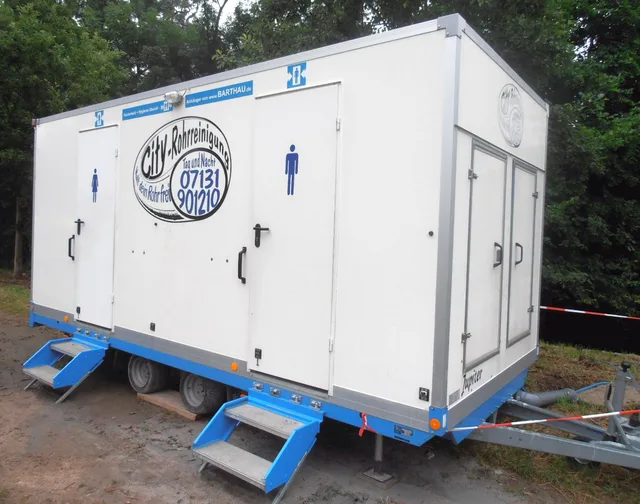
Range. A new class of unit or service, such as trailers or hand-wash provision. Demands new handling, new cleaning and sometimes water and power dependencies, which is why it is discussed in what to buy and in what order.
Qualifying a second territory
Do it as a sequence of gates. Failing gate one ends the exercise; there is no point scoring the rest.
Second territory gate sequence
- Receiving point terms and hours
- Distance to work and truck-day effect
- Registrations in that jurisdiction
- Demand generators near receiving point
- Who serves it and the gap
- Winter effect, if any
- Existing yard or its own
Gate three is the one operators discover late. Crossing a county or state line can introduce a second registration for work that looks identical, and the method for finding out is in which authorities regulate this trade.
Counting demand rather than population
Population tells you almost nothing here. What tells you something is the number of things happening that create the need.
Permits issued for work with a long schedule. Venues that hold permitted events, and how often. Agencies that buy on contract. Sites with people and no plumbing, such as trailheads, campgrounds and boat ramps. Seasonal work: harvests, festivals, road programs.
Count those inside the radius drawn around the candidate receiving point. The SBA's business guide covers how market research and expansion planning fit together for a small business, and the part it cannot supply is the local count, which is the only part that matters.
The second driver comes before the second truck
Capacity in this business is truck-days, and a truck without a driver produces none. The order is usually to add driver hours, then a second shift where the work allows it, then a second vehicle.
Capacity order: driver before truck
- Add driver hours
- Add a second shift where work allows
- Add a second vehicle
Labor also decides how fast you can grow. The Bureau of Labor Statistics wage tables publish occupational wage estimates by area. That is a reasonable check on whether your planned pay is competitive in the market you are entering, since a route in a new territory competes for drivers with everyone else there.
Consider what a vehicle above a licensing threshold does to your hiring pool before you buy it. A truck that only two people in the county may drive is a capacity problem disguised as an asset.
The second yard, and when it is unavoidable
A second yard is expensive and sometimes necessary. The test is not distance from the office; it is whether units can be turned around fast enough to serve the new territory from the old yard.
If a returned unit has to travel two hours to be cleaned and two hours back, the new territory is consuming truck-days it does not generate revenue for. That, rather than sentiment about a base, is what decides it.
What breaks first when a rental fleet grows
Dispatch. One person holding the route in their head stops working somewhere between one truck and two, and the failure is silent: exceptions stop being reviewed and nobody notices.
What breaks first as fleet grows
- Dispatch held in one person's head
- Units deployed with no contract line
- Second driver serves units differently
- Yard jams before anyone expands it
Records. Units deployed with no contract line accumulate faster than anyone reconciles, which is the argument for the measures in what a fleet record system must hold.
Service consistency. A second driver serves units differently unless the standard is written down and inspected. That is the case for the operating day end to end being a document rather than a habit.
The yard. It is always the last thing anyone expands and usually the first thing that jams.
Growing without assets
Subcontracting overflow to another operator, taking their overflow in return, or partnering on a large event are all normal in this trade. Rental yards in neighboring towns are competitors on one job and suppliers on the next.
Agree in advance how damage, shortfall and service standards are handled, and remember that work performed on your behalf still carries your name onto the site. Your customers' own sanitation obligations do not change because you subcontracted; the workplace baseline is set out in OSHA's sanitation standard, with state plans and permit conditions capable of adding to it.
Deciding to stay the size you are
A route business at the right size, with a dense book of standing orders and a paid-for fleet, is a good business. Growth that adds a truck, a driver and a territory can easily produce more revenue and less profit.
Before expanding, work out what the current operation would earn if the same effort went into density instead. Frequently the honest answer is that it would earn more, and that answer is available in the pricing arithmetic described in where the money is made and lost and the buyer picture in who actually buys this service.
Common questions
How do I know when the current territory is full?
When adding work no longer reduces the average drive between stops, and when the truck-day is spending more time driving than servicing. Both are measurable from route records rather than from feel.
Should a new territory be tested before committing?
Yes, if it can be. Serving a handful of stops there from the existing yard for a season tells you the real drive times, the real access problems and the real seasonality, at a much lower cost than a second base.
Is acquiring another operator a sensible route to growth?
It can be, and the value sits in the book of standing orders and the route density rather than in the fleet. A yard full of units with no committed work is stored capital.
What is the most common expansion mistake?
Buying the second truck to solve a problem that was really a routing problem. It arrives with a fixed cost, and the density that would have made it pay was never built.