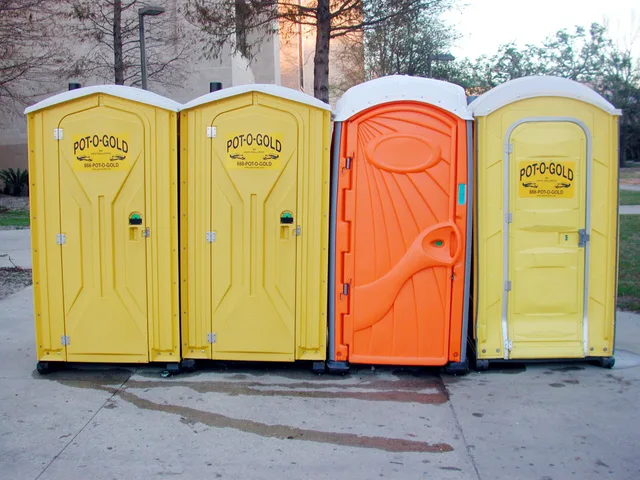
![[Hurricane Katrina] Algiers, LA., 10/29/2005 -- A line of portable toilets at a Base Camp. Base camps were set up in various locations around New orleans for rescue workers and volunteers needing housing following Hurricane Katrina. Andrea Booher/FEMA. OSHA sanitation rules for construction sites: how many portable restrooms per worker](/covers/osha-sanitation-rules-construction-portable-restrooms-1920.webp?v=97083974)
Guides
OSHA sanitation rules for construction sites: how many portable restrooms per worker
The federal construction sanitation table sets toilet and urinal counts by crew size, and that ratio decides how many units you place and quote.
What to take away
- 29 CFR 1926.51 sets the federal construction ratiosone toilet for 20 or fewer workers, then one toilet seat and one urinal per 40 workers up to 199, and per 50 workers at 200 and above.
- The ratio is a floor. A 60 worker site needs two seats and two urinals, and urinals do not substitute for toilets one for one.
- Inspectors count bodies on site that day, including subcontractors, delivery drivers and themselves, so bid the peak week, not the average.
- About half the states run OSHA-approved plans that must be at least as effective as federal OSHA, and some are stricter.
- Size the unit count from the ratio first, then add service, water and washing, and check the bid against cost per worker per week.
What 29 CFR 1926.51 actually requires
The federal construction sanitation standard is short enough to read once a year. It covers toilets, urinals, washing facilities and potable water.
OSHA publishes the federal construction sanitation ratios in a table that scales with the crew. The eCFR carries the authoritative text of 29 CFR 1926.51 when you need exact wording for a bid or a dispute.
OSHA Construction Toilet Ratios
- 20 or fewer1 toilet
- 20 to 1991 seat + 1 urinal per 40
- 200 or more1 seat + 1 urinal per 50
Two details decide unit counts. The 1 per 40 band is a floor, so 60 workers means two seats and two urinals, not one of each. Urinals cannot be swapped for toilets one for one.
Shifts do not stack. The table sizes facilities to the workers present at one time, so a day shift and a night shift of 80 each still needs facilities for 80.
Washing facilities are required where workers handle paints, coatings or other harmful substances, and the standard points to suitable facilities for quick drenching or flushing of eyes and body.
If your units run on a predictable service cycle, the ratio math holds across a long job. That is the operational half of what inspectors expect when they walk a site.
Counting workers the way an inspector counts them
Who Counts on Site
- Electrical and mechanical subs
- Concrete crews
- Crane operators
- Delivery drivers who stay
- The inspector
A 45 person framing crew plus a 20 person mechanical crew plus deliveries pushes a small site past 60 workers fast. OSHA letters of interpretation explain how the agency applies the standard, including who counts and when facilities must be available.
Construction headcount swings. Peak days drive the requirement, and inspectors look at the day they visit.
Ask the general contractor for the manpower schedule, not a single number. Peak weeks are what you bid.
If the GC will not commit to a headcount in writing, bid the number you can defend and write that assumption on the quote. The change order conversation stays short.
Site layout matters. Toilets must be accessible, and on a spread out site that can mean more units placed closer to work fronts even when the raw ratio is met. A single ground level unit for a 12 story tower will draw a complaint, and complaints drive inspections.
Keep a log of units on site by day. When an inspector asks why four units cover 70 workers, the log shows you planned to the peak.
Potable water, cups and the details owners forget
Potable water is required at every construction site and must be dispensed in a sanitary way. A shared garden hose and a dirty cooler is the common failure.
Often-Missed Bid Lines
- Water service
- Hand wash stations at each toilet cluster
- Waste pickup for cups and trash
Single use cups are required where water is not delivered by a fountain or sanitary drinking station. That means cups, a dispenser and a trash plan.
Volume has to match the crew and the heat. One cooler for 40 workers will not last a shift in a Phoenix summer, and the refill run is a service call you did not price.
Three lines get left off bids: water service, hand wash stations at each toilet cluster, and waste pickup for cups and trash. Each carries a cost.
Hand sanitizer does not replace washing facilities where the standard requires washing. Do not let a GC talk you into the swap.
Service frequency drives complaints more than unit count. A 20 worker site on weekly service in a Texas summer smells worse than a 200 worker site on daily service.
Non-sewered waste systems also fall under ANSI/PSAI Z4.3, which sets construction and performance expectations for portable units. That standard is separate from OSHA and shows up in specs anyway.
Disposal is regulated separately. EPA rules and state health department septage hauling rules govern where your pumper can dump, and those rules vary by state and sometimes by county. Confirm the current rule with the state environmental agency and the receiving treatment facility.
How state plan states differ from federal enforcement
About half the states run OSHA-approved plans, and each must be at least as effective as federal OSHA. Many are stricter.
California, Washington, Oregon, Michigan and Utah run plans covering private construction. New York and New Jersey cover public sector workers only.
In a state plan state the citation comes from the state agency, not federal OSHA. Bid the state number when it is stricter.
State plans can add requirements federal OSHA does not have, including restroom temperature, hand wash specifics or potable water volume. Some states also require portable toilet permits at the local health department for longer placements, and some require septage manifests. Those sit outside OSHA but surface in audits.
If you work across state lines, keep a one page summary per state in the bid folder. It saves a rewrite every time a GC moves a project across the border.
State plans publish their own penalty schedules, and repeat sanitation citations climb faster under some of them. Fix a service gap before the second visit.
Turning the ratio into a quote
Build the unit count first, then layer service, water and washing, then divide by headcount to sanity check the bid.
90-Worker Georgia Site Quote
- Count peak workers90
- 3 seats and 3 urinals, round to 4 units
- Add 2 hand wash stations plus 1
- Add water trailer or 2 coolers
- Service twice weekly for 26 weeks
- Price units, service, water, delivery, fuel, dump
Worked example: a 90 worker site in Georgia, six month duration, one shift, five day week.
- Count workers at peak90. Under 1 seat and 1 urinal per 40, that is 3 seats and 3 urinals. Round to 4 standard units for placement and access.
- Add washing2 hand wash stations at the main cluster, 1 at the far cluster.
- Add water1 water trailer or 2 large coolers with cups, refilled twice weekly.
- Set service4 units, twice weekly pump and wash for 26 weeks, plus one extra service after concrete pours.
- Price units, service, water, delivery, fuel and dump.
The per head check: contract price divided by 90 workers divided by 26 weeks gives weekly cost per worker. If that number sits far below your normal range, a line is missing.
Two lines belong in every construction bid: a fuel surcharge tied to drive distance, and a dump fee per service. Both scale with job length, not unit count.
Service frequency is the biggest lever. Weekly to twice weekly adds cost and cuts complaints, which protects the contract. The parts of pricing owners underprice most are service, dump fees and delivery.
Do not price from the unit alone. Price from the drive, the dump and the service window, then let unit count fall out of the ratio. Owners who price from the drive stop losing money on long hauls.
Keep a reusable quote template with the ratio table built in. It forces the count before the price.
Where 1910.141 applies instead
Warehouses, plants, yards and some maintenance work fall under general industry rules, not construction.
OSHA's general industry sanitation requirements appear in 29 CFR 1910.141, covering toilet rooms, washing facilities, potable water and waste disposal for non-construction workplaces.
1910.141 does not use the construction worker table. It requires toilet facilities, and the count is often driven by employee numbers and shift length rather than a fixed ratio.
The general industry rule also addresses privacy. Where both sexes are employed, facilities must be separated or use a single room with a locking door, and portable units rented to a plant are judged the same way.
Where a site has both construction and general industry work, the construction standard usually governs the construction portion. Get the scope in writing before you bid.
For temporary shutdowns and plant turnarounds, the customer often specifies a ratio in the contract. Bid the stricter of the contract and the standard.
Documentation an inspector asks to see
Inspectors rarely arrive with a visible checklist. They ask questions and look at units, so paperwork should answer before they ask.
Inspector Documentation Binder
- Service tickets, dated and signed, last 30 days
- Unit count by day matching peak headcount
- Potable water and cup restock records
- Hand wash station and soap refill records
- Septage disposal manifests
- Local portable toilet permits
- One page ratio worksheet
Keep a binder in the truck and a copy in the office. When an inspector asks for service records, a binder beats a phone call to the yard.
Photograph each unit at service with the timestamp on. A dated photo answers most questions about condition and placement without a debate.
The construction industry pages at OSHA help new owners speak the same language as the GC's safety officer.
Service quality is the other half of compliance. Units serviced on schedule and stocked correctly pass visual inspection, and keeping to standard is cheaper than defending a citation.
Common questions
How many portable toilets does OSHA require for 50 construction workers?
Fifty workers falls in the 20 to 199 band, so the federal table calls for 1 toilet seat and 1 urinal per 40 workers. That rounds to 2 seats and 2 urinals, and most fleets place 2 to 3 standard units for access.
Do state plan states use the same toilet ratio as federal OSHA?
Not always. State plans must be at least as effective as federal OSHA, and some adopt stricter ratios or add requirements. Check the state manual before you bid.
Is hand sanitizer enough where washing facilities are required?
No. Where the standard requires washing facilities, sanitizer does not replace them. Provide hand wash stations with water, soap and towels.
Who counts toward the worker total on a jobsite?
Everyone on site during the inspection, including subcontractors, delivery drivers who remain on site and the inspector. Bid the peak headcount, not the average.
Does OSHA set a maximum walking distance to the toilet?
The federal construction standard does not fix a distance. Inspectors judge accessibility, so place units near the active work front and expect a citation if crews walk across a large site.